Years

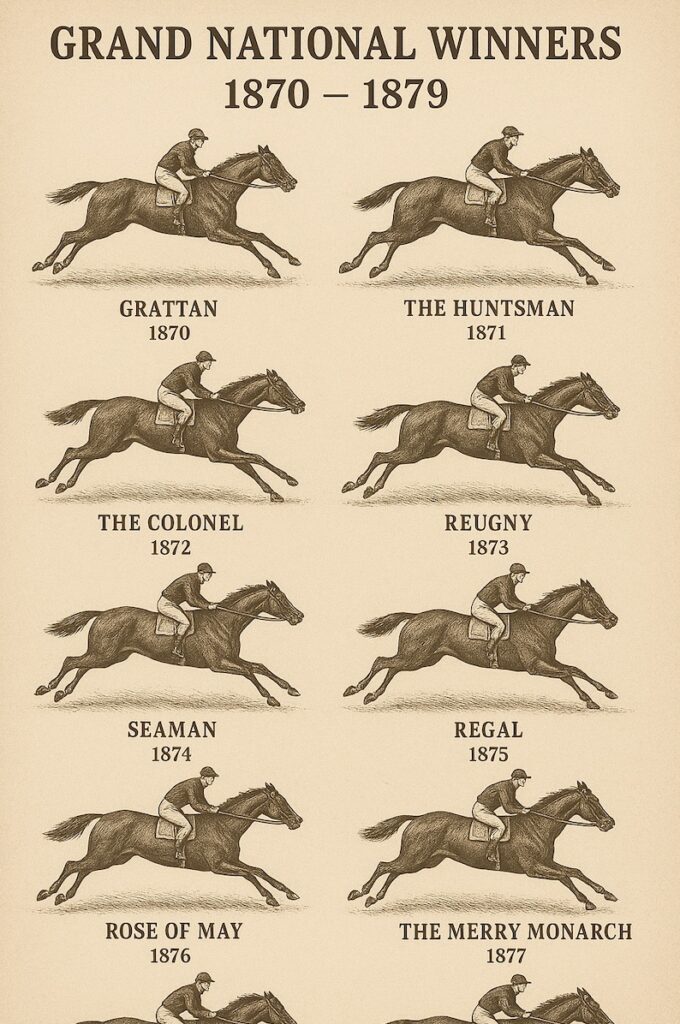
Grand National Winners 1870 – 1879

grand national 1870 - 1879
Screenshot

A time of major political, social and industrial change. The Education Act 1870 saw the first steps towards compulsory elementary education for all children. The introduction of secret ballot boxes in 1872 would reduce voter intimidation and corruption in elections. The Licensing Act 1872 tightened regulations on the sale and consumption of alcohol. Gladstone was in power for the Liberal Government until 1874.

Disraeli would hold out until the end of the decade for the Conservative Party (1874 -1880). For the most part the emphasis was social reform. The Factory Act 1874 limited working hours for women and children. Local authorities were forced to improve sanitisation and clear slums. The Education Act 1876 made school attendance compulsory up to the age of 10. It is worth remembering that before 1870, children started work as young and 5-6 years old, especially from poor families. Their jobs included: factory work, mining, agriculture, street sellers and chimney sweeps. Life expectancy for a man was just 40 years.

The British Empire proved strong leading industry, although competition from the US and Germany emerged. Britain secured Cyprus to increase its influence in the Mediterranean, while the Zulu War (1879) and the Second Anglo-Afghan War (1878 – 1880) raged. Railways expanded further, trade unions strengthened and urbanization continued. Rising literacy rates saw increased popularity in newspapers and mass political engagement. Charles Dickens’ work and Thomas Hardy’s Far From the Madding Crowd (1874) were must reads. Within the world of science and technology, Darwin’s Theory of Evolution sparked debate with the publication of The Descent of Man (1871).

The FA Cup founded in 1871 and The Grand National were major sporting events.

A decade of Grand National winners saw a mixed bag of results.

1870: The Colonel started where he had left off in 1869, winning the 32nd renewal for a second time by a neck from The Doctor. R.Roberts would train National winners in consecutive years but never again. However, Jockey George Stevens won this steeplechase 5 times (1856 – 1870). He is famous for having the most wins in the Grand National. He died in 1871 when fracturing his skull in a fall after his horse stumbled while riding home to his cottage on Cleeve Hill. He was just 38 years old.

Let’s take look at this decade of Grand National Winners:

1870 – The Colonel 7/2f

1871 – The Lamb 11/2

1872 – Casse Tete 20/1

1873 – Disturbance 20/1

1874 – Reugny 5/1f

1875 – Pathfinder 100/6

1876 – Regal 25/1

1877 – Austerlitz 15/1

1878 – Shifnal 7/1

1879 – The Liberator 5/1

1873: Disturbance beat a 28-strong field to win the 35th renewal by six lengths for trainer-rider Mr. J. M. Richardson in the ownership of James Octavius Machell who was a highly successful gambler. He was also a good judge of a horse and trained eleven English Classic winners. He owned two other Grand National winners: Reugny (1874) and Regal (1876).

The victory of Disturbance was somewhat novel with the news that a finishing time wasn’t taken as the watch stopped!

Machell, the son of a reverend, joined the army in 1857 and was involved in the suppression of the Indian Mutiny. Returning home, he was quartered at the Curragh, Ireland. During the next six years, he participated in horse racing. By 1862, he was one of the leading owners in Ireland. He was promoted to Captain. However, army life conflicted with horse racing so he resigned his commission and trained at stables in Kennett near Newmarket, Suffolk. In 1864, he landed a major gambling coup when Bacchus, a horse he trained in Ireland, which gave him funds to purchase Bedford Cottage Stables in Newmarket.

Never one to miss out on a good wager, Machell defeated a local running champion in a 100 yard sprint.

He was known for manipulating betting markets much to the dismay of John Richardson the jockey and trainer of both National winners Disturbance (1873) and Reugny (1874). He said he had been so ‘disgusted with the sordid nature’ of Machell’s behaviour that he withdrew from public riding after the latter Grand National.

Machell was said to be obsessed with horses and racing to the point he would spend a great part of his time making imaginary handicaps.

Other points to note include Chris Green who trained the 1871 winner The Lamb. He was also a talented jockey who rode two Aintree Grand National victories on Abd-El-Kadar (1850) and Half Caste (1859).

The Liberator concluded this period winning in 1879 at odds of 5/1. The ten-year-old Irish gelding won by ten lengths, ridden by rider-owner Mr Garret Moore, trained by J. Moore.
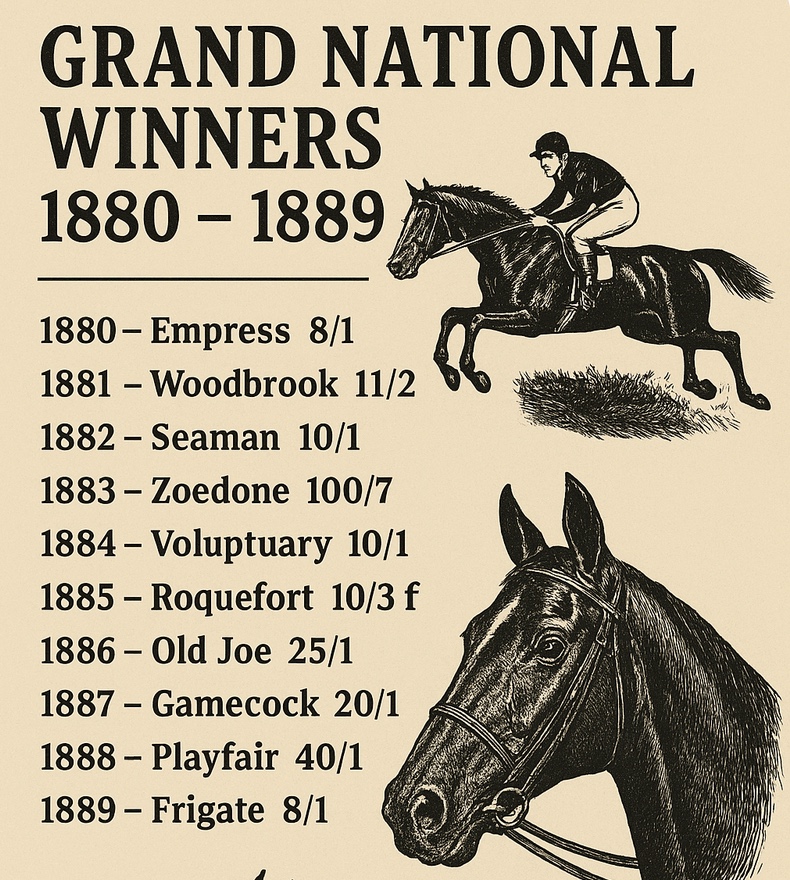
Grand National Winners 1880 – 1889

William Gladstone won the 1880 General Election, leading to over a decade of Conservative rule. This may have been helped by the 1884 Representation of the people Act which doubled the electorate by giving the vote to many rural working men. Britain expanded colonial rule in Egypt. In 1885, the public was shocked to hear General Charles Gordon was killed in the Sudan Crisis during the Mahdist uprising. The rise in new unionism saw the Matchgirls’ Strike (1888) highlighting labour conditions and workers’ rights. Elementary schools were more common and literacy rates rose. Oscar Wilde was popular within arts and literature. While Jack The Ripper lurked somewhere in the poverty-stricken streets of Whitechapel, London. The Married Women’s Poverty Act allowed married women to own property in their own right. Electricity and telephone uptake grew in the 1880s although it was only for business and wealthy individuals. At this time, betting was still done in person, on the street or on course.
The Aintree Grand National remained extremely popular.

Let’s take a look at the winners from this decade:

1880 – Empress 8/1

1881 – Woodbrook 11/2 jf

1882 – Seaman 10/1

1883 – Zoedone 100/7

1884 – Voluptuary 10/1

1885 – Roquefort 10/3 f

1886 – Old Joe 25/1

1887 – Gamecock 20/1

1888 – Playfair 40/1

1889 – Frigate 8/1

A couple of jockeys proved positive with 5 wins between them. Mr Tommy Beasley had the first two winners of the decade riding for Henry Linde. In relatively small fields, Empress and Woodbrook took the 42nd and 43rd Aintree Grand Nationals by less than four lengths each. The trainer and jockey, both from Ireland.

Beasley would taste victory once more with the victory of Frigate in 1889 for trainer-owner Mat Maher. The 11 year old won at odds of 8/1 by one length from Why Not, who would go on to win the National in 1894.

Mr Ted Wilson was the other jockey to make his mark with two wins in the mid part of the decade with Voluptuary (1884) and Roquefort (1885).

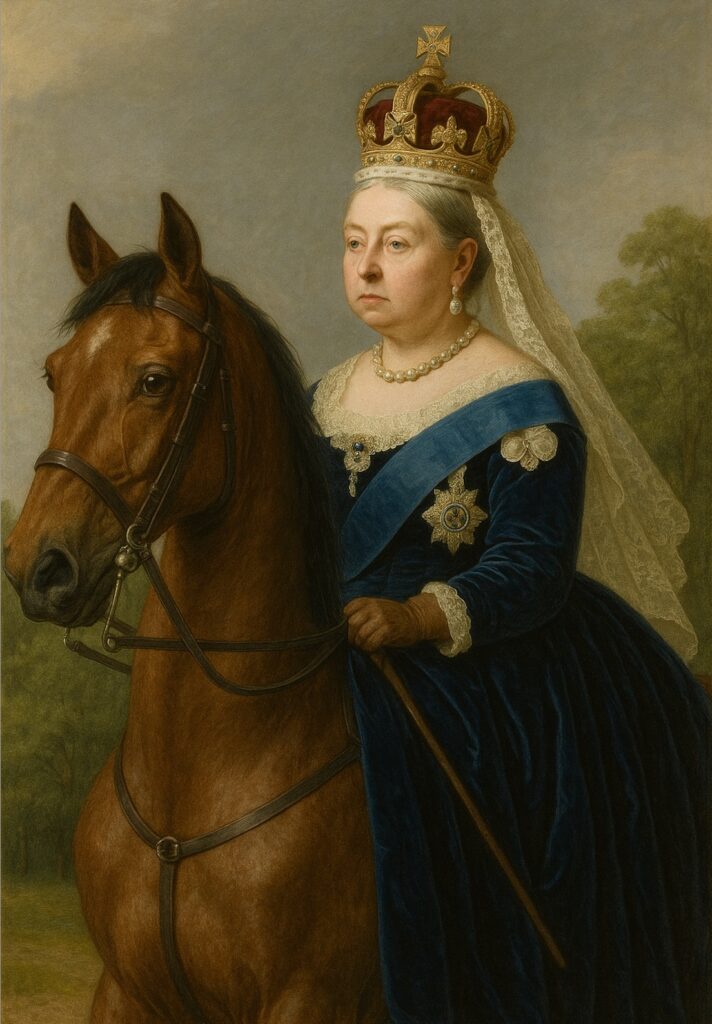
Voluptuary raced on the flat. In fact, he ran in the Epsom Derby. He was the first winner of the Aintree Grand National without having previous experience in the race. Interestingly, the bay gelding was bred by Queen Victoria. After retirement, he received critical acclaim portraying the racehorse ‘The Duke’ in the play The Prodigal Daughter. Originally in the ownership of Lord Roseberry, he won the National in the silks of H.F.Boyd at odds of 10/1. Interestingly, Voluptuary was originally named Battersea. However, his name was changed before this racing career.

Roquefort was the shortest priced of this decade when winning for Wilson at the odds of 10/3f, trained by Arthur Yates in the ownership of Arthur Cooper. The six-year-old gelding won by two length from Frigate, who would be the star of the show in 1889.

There is an interesting story behind the 1882 winner Seaman. It is as much a story about owner as horse because Lord Manners made a wager. John Thomas Manners-Sutton, a nobleman, liked a bet and he wagered he could buy, train and ride the winner of the 1882 Aintree Grand National. Added to the scenario he only had months to prepare. The horse was bought from an Irish man who questioned whether it could achieve the standard to compete in such a prestigious race. Few believed Manners had the riding skills or experience necessary. By the day of the race, the weather was horrendous with snow storms and ice which played in Manners’ favour. While other jockeys were more cautious and held back, Manners pushed on until drawing level with the favourite at the last fence. Seaman, started to go lame, but the pair won by a short head.

Seaman won at odds of 10/1.

The winning wager must have been substantial as he built a 52 room mansion called Avon Tyrroll at Sopley, Hampshire. The Grade I listed building is considered to be one of the archetypal Arts & Crafts buildings. Commonly known as a calendar house.

Although Seaman never raced again, he lived with the family and family home for the rest of his life. He was buried between two trees on the grounds.

What a story.

This decade had a number of big priced winners including:

1886 – Old Joe 25/1

1887 – Gamecock 20/1

1888 – Play Fair 40/1

As seen with this post, the Aintree Grand National is a race of the great and the good.

It is worth noting that nobility was attracted to the Grand National like no other race. For example, in 1883 Zoedone won at odds of 100/7. The chestnut mare was not only owned but ridden by a very rich Count from Austria.

His full title: Karl, 8th Prince Kinsky of Wchinitz and Tettau.

He has two ambitions in life: to be made Austo-Hungarian attache to Britain and the second to own and ride a Grand National winner.

Grand National Winners 1890 – 1899

To give context, it was the last decade of Queen Victoria’s reign. Britain remained the ‘workshop of the world’ with railways, shipping and heavy industry. Emerging technologies included electricity, auto mobiles and telephones. The decline of agriculture saw more people move into cities and industrial jobs. This was a time when the British Empire was at its height, covering nearly a quarter of the world’s land after expanding into parts of Africa. The suffrage movement gained momentum. The 1891 Education Act saw free schooling. Charles Booth’s survey of London revealed the harsh realities of urban poverty influencing early welfare reforms. Football and cricket became mass spectator sports (The Football League founded in 1888). The Grand National was established as the country’s most famous steeplechase. In fact, horse racing was one of the most popular pastimes followed by both upper and working classes. Although off-course betting was technically illegal it flourished. Steeplechasing had a reputation of danger, attracting huge crowds. The growth of rail travel saw 40,000 spectators head to Aintree.

 
The Grand National remained the toughest steeplechase in the world. Field sizes ranged from 20 – 30 horses and fences were formidable, including Becher’s Brook, Canal Turn and The Chair, in front of the stands, which saw dramatic falls. It was a hard race for both horse and jockey.
Let’s take a look at the winners from 1890 – 1899.
This decade saw 5 winning favourites (* Highlighted):
  • 1890 – Ilex 4/1f *

  • 1891 – Come Away 4/1f *

  • 1892 – Father O’Flynn 20/1

  • 1893 – Cloister 9/2f *

  • 1894 – Why Not 5/1jf *

  • 1895 – Wild Man Of Borneo 10/1

  • 1896 – The Soarer 40/1

  • 1897 – Manifesto 6/1f *

  • 1898 – Drogheda 25/1

  • 1899 – Manifesto 5/1

Horse trainer Willie Moore won the race three times with Why Not (1894), The Soarer (1896) and Manifesto (1899).

Most notables winners include the twice-winning Manifesto who prevailed in 1897 and 1899. He won the 59th and 61st running of the Aintree Grand National. He ran a record 8 times from 1895 – 1904.

Manifesto Aintree Grand National Race record:

1895 – 4th

1896 – Fell (first fence)

1897 – 1st

1899 – 1st

1900 – 3rd

1902 – 3rd

1903 – 3rd

1904 – 8th

A truly consistent bay gelding, bred by Harry Dyas, in the ownership of Dyas and Mr J. G. Bulteel. He was purchased by the latter in 1898 being sold for £4,000 and sent to Willie Moore’s stable.

He was intended to run in the 1898 Grand National but escaped when a stable boy left stable door open. Manifesto was recaptured but suffered a badly bruised fetlock after jumping a gate. He missed the National. However, he proved successful the following year under a weight of 12 stone 7 Ilbs. He won by five lengths from 40/1 shot Ford Of Fyne.

Manifesto won a prize of £3,000. A considerable amount of money for this time. For context, a working-class terrace house cost £250.

He was retired after the 1904 Grand National.

Another horse who deserves recognition is the 1893 winner Cloisters. A remarkably consistent horse who made his National debut in 1891, where he finished runner-up, ridden by Captain Roddy Owen.

Let’s take a look at his Aintree performances:

1891 – 2nd 20/1

1892 – 2nd 11/2

1893 – 1st 9/2f

Cloisters was considered one of the greatest National winners although a fragile horse who suffered injuries. His 1893 win by 40-lengths at top weight made him legendary at this time. In fact, he completed the course in a remarkable fast time of 9m 42 seconds. This was due to firm ground.

This decade of Grand National winners (1890 – 1899) saw an equal mix of winning favourites. Horses winning at greater odds included:

1892 – Father O’Flynn 20/1

1896 – The Soarer 40/1

1898 – Drogheda 25/1

With regard to the age of winners, the youngest saw the Ilex prevail in 1890 aged 6. While the oldest being Why Not in 1894 aged 13. It should be noted he is one of only two horses to win at such an age in the history of the Aintree Grand National, which dates back to 1839. The other horse being Sergeant Murphy (1923).

As for winning jockeys, Arthur Nightingall won twice with Ilex (1890) and Why Not (1894). He went on to win again in 1901 when riding Grudon for trainer Bernard Bletsoe. It was an unusual National as it was run in a snow storm. The conditions of the race race were described as ‘very bad’.

In summary, this decade of Aintree Grand Nationals from 1890 – 1899 saw a mix of winners.

It’s worth noting that the Wild Man Of Borneo (1895) was the name of the horse rather than the jockey.

Grand National 2025 Preview – Contenders

The 2025 Grand National is scheduled for 16:00 on April 5, but entries for the world-famous steeplechase closed on January 28 and the weights were published on February 11, allowing the ante-post market to take shape. At the time of writing, after the first scratching deadline on February 25, 81 horses stood their ground in the National which, nowadays, has a safety limit of 34. A further scratching deadline follows on February 25, with five-day declarations on March 31 and 48-hour declarations on April 3, before the final field is revealed. At that stage, all bar the top 34 in the weights will be ballotted out, leaving the remainder to compete for £1 million in prize money, half of which goes to winning connections.

At the time of writing, the weights are headed by the 2024 winner, I Am Maximus (14/1), trained by Willie Mullins, who has since been plying his trade, without much distinction in Grade 1 company. The Authorized gelding was pulled up, when tailed off, behind stable companion Galopin Des Champs in the Savills Chase at Leopardstown over Christmas on his seasonal debut, but fared a little better when a keeping on eighth, beaten 17 lengths, behind the same horse in the Irish Gold Cup, over the same course and distance, in early February. That latter piece of form leaves him nearly 10 lengths to find with ante-post favourite Inothewayurthinkin (8/1), who is also owned J.P. McManus, with whom he is 7lb worse off at Aintree. I Am Maximus is 8lb higher in the weights this year than last, but back at Aintree could well leave his previous form this season well behind.

Of course,  with a focus on Grand National Runners , I Am Maximus potentially faces a whole raft of formidable rivals, some of who are also trained by Willie Mullins and/or owned by J.P. McManus. Nick Rockett (14/1), for example, is a stable companion at Muine Bheag, Co. Carlow and boasts solid credentials, not least because he has won the Grade 3 Bobbyjo Chase at Fairyhouse since the National weights were published. On that occasion, he edged out Intense Raffles (10/1), who could re-oppose on 15lb better terms, for just three-quarters of a length, at Aintree and appears remarkably well handicapped on that evidence. Nevertheless, Nick Rockett remains a progressive, stoutly-bred eight-year-old, who ran creditably on his only previous visit to Britain, in the Bet365 Gold Cup at Sandown last spring, and is definitely one to consider.

Strictly speaking, Nick Rockett also has his work cut out to reverse earlier form with Perceval Legallois (20/1), who beat him by just over nine lengths in the Paddy Power Chase at Leopardstown over Christmas and is 11lb better off in the National. Owned by McManus and trained by Gavin Cromwell in Navan, Co. Meath, Perceval Legallois is a stable companion of Inothewayurthinkin, but is clearly no slouch, having taking advantage of a lower hurdles mark to win a valuable race in that sphere at Leopardstown on his most recent outing in early February. He has yet to win beyond an extended three miles, but acts on any going and still looks reasonably handicapped on what he has achieved so far.

Gavin Cromwell could also saddle Stumptown (20/1), who is an intresting contender insofar as he is, at the time of writing, 3-4 in cross country chases and ante-post favourite for the Glenfarclas Cross Country Chase at the Cheltenham Festival. He is lumbered with top weight of 11st 10lb at Prestbury Park but, as the weights stand, set to carry 8lb less at Aintree. He could seek to emulate Tiger Roll, who won the Glenfarclas Cross Country Chase (albeit when it was still a conditions race, rather than a handicap) en route to Grand National glory in both 2018 and 2019.

Iroko (14/1), trained by Oliver Greenall and Josh Guerriero in Oldcastle Heath, Cheshire, but yet another owned by that man McManus, is currently the shortest-priced of the home contigent. The winner of the Martin Pipe Conditional Jockeys’ Handicap Hurdle at the 2023 Cheltenham Festival, he has not won since November that year and is currently just 1-7 over fences, for all that he has been highly tried more than once in his steeplechasing career. Indeed, he is well handicapped with Inothewayurthinkin on their running in the Mildmay Novices’ Chase at Aintree last April. A first fence fall, albeit after being hampered by a rival, in a graduation chase at Ascot tempers enthusiasm for his chances of completing the National Course without mishap, but his subsequent, tenderly-handled fourth at Newbury (which was subject to a stewards’ enquiry) suggests there is some mileage in his current handicap mark if he does.

Now 14-time champion trainer Paul Nicholls knows what it takes to win the Grand National, having done so, narrowly, with Neptune Collonges in 2012. The Master of Manor Farm has a handful of entries in 2025, the pick of which, according to the bookmakers, could be Kandoo Kid (25/1). The nine-year-old son of useful jumps sire Kapgarde already has experience of the National fences, having finished a close third in the Topham Chase last April. He also won the Coral Gold Cup at Newbury – the form of which has been franked, more than once – on his seasonal reappearance in November. Making excuses for beaten horses can be an expensive business, but the combination of a 7lb rise in the weights, a 91-break and the drop back to two and a half miles may have contributed to his subsequent defeat in the Greatwood Gold Cup. Kandoo Kid remains of interest, despite obvious stamina doubts.

Grand National Winners 1910 – 1919

If there was one defining aspect of this decade, it was World War I. Life changed for many, and the four years, three months, and fourteen days of conflict couldn’t end soon enough. Tragically, an estimated 16 to 20 million people and animals lost their lives.

Many ex-racehorses were among the casualties, particularly in the cavalry. For example, offspring of Cloister, the 1893 Grand National winner, were used in military service.

The Suffragette movement also played a significant role during this time, led by Emmeline Pankhurst and her Women’s Social and Political Union (WSPU), which gained momentum in 1912. Many will be familiar with the tragic footage of Emily Wilding Davison (1872–1913), who died after being struck by King George V’s horse at the 1913 Epsom Derby. While the Suffragettes disrupted several races at Aintree, none were as dramatic as Davison’s protest.

It wasn’t until 1918 that some women were granted the right to vote.

This was a time of great social unrest, and the country breathed a sigh of relief when the Treaty of Versailles (1919) officially marked the end of the war.

For the most part, the Aintree Grand National helped maintain national morale and resilience.

However, from 1916 to 1918, the world’s most famous steeplechase was canceled at Aintree as the nation prioritized fighting for King and country. Instead, the Grand National was held for three years at Gatwick Racecourse, now the site of London Gatwick Airport. The race was run over the same distance but with one fewer jump (29) and was officially called *The Racecourse Association Steeplechase. The course closed in 1940 with the onset of World War II.

Grand National Winners (1910–1919):

  • 1910 – Jenkinstown (Tom Coulthwaite)

  • 1911 – Glenside (R. H. Collins)

  • 1912 – Jerry M (Robert Gore)

  • 1913 – Covertcoat (Robert Gore)

  • 1914 – Sunloch (Tom Tyler)

  • 1915 – Ally Sloper (Aubrey Hastings)

  • 1916 – Vermouth (J. Bell) *

  • 1917 – Ballymacad (Aubrey Hastings) *

  • 1918 – Poethlyn (Harry Escott) *

  • 1919 – Poethlyn (Harry Escott)

(* Races held at Gatwick Racecourse.)

Notable Moments from the Decade:

1910 – Jenkinstown (100/8)

Tom Coulthwaite’s winner, owned by Stanley Howard, was one of the earliest Grand Nationals captured on moving film, thanks to British Pathé, founded in Paris by Charles Pathé in 1896.

1911 – Glenside (20/1)

A remarkable winner, Glenside was a horse with respiratory problems (broken-winded) and only one eye. Torrential rain meant that only four of the twenty-six runners finished, with Glenside winning by twenty lengths.

1912–1913 – Jerry M (4/1) & Covertcoat (100/9)

These two years were dominated by Robert Gore & Sir Charles Assheton-Smith.

  • In 1912, Ernie Piggott (grandfather of Lester Piggott) rode Jerry M, carrying 12st 7lb, to victory. The horse had finished runner-up to Jenkinstown (1910) but this time secured a six-length win as the 4/1 favorite.

  • In 1913, Percy Woodland guided Covertcoat to victory, winning by a distance, with only three finishers in the race.

Interesting Aside:

Sir Charles Assheton-Smith, who won the 1912 and 1913 Grand Nationals, had also owned the 1893 Aintree Grand National winner—but under the name Charles Duff.

1914 – Sunloch (100/6)

The 76th Grand National was won by Sunloch, owned and trained by Tom Tyler, at odds of 100/6.

1915 – Ally Sloper (100/8)

A historic moment as Lady Margaret Nelson became the first female owner to win the race.

1916–1918: The Racecourse Association Steeplechase (Known as the War Steeplechase)

During World War I, Aintree was closed, as it was taken over by the War Office (1914–1918). The Grand National was instead held at Gatwick Racecourse, which later closed in 1940, becoming London Gatwick Airport.

Winners of the War Steeplechase:

  • 1916 – Vermouth (J. Bell) 100/8

  • 1917 – Ballymacad (Aubrey Hastings) 100/9

  • 1918 – Poethlyn (Harry Escott) 5/1

1918–1919: Poethlyn Does the Double

To conclude the decade, the nine-year-old gelding Poethlyn secured back-to-back victories at Gatwick (1918) and Aintree (1919).

  • Ridden by: Ernie Piggott

  • Trained by: Harry Escott

  • Owned by: Gwlady Peel

Poethlyn was a highly fancied contender, winning at odds of 5/1 and 11/4, respectively. In his 1919 Aintree win, Poethlyn carried an additional 1st 1lb compared to the previous year, yet still emerged victorious.

He remains the shortest-priced winner in Grand National history.