Questions

The Breeders’ Cup: Why It Matters to UK Horse Racing Fans

The Breeders’ Cup lands at the end of the flat season with a simple promise. Two days. Fourteen high-grade tests. Form lines from both sides of the Atlantic, colliding at full speed.

For a UK racing fan, it is not just a late-night watch. It is a chance to benchmark European stock against elite North American opposition and to find edges that domestic cards rarely offer.

Let’s map the races, the track quirks, and the angles that turn this meeting into a clear opportunity.

Two Days That Reset End-of-Season Thinking

The meeting closes the global flat year with a clean scoreboard. Races span Turf and dirt across sprint, Mile, and middle distances, giving a UK bettor or analyst the chance to test every angle built since the spring. European stables tend to target the turf programme because it mirrors home conditions and offers multi-million million pots across the Mile, Turf, and Filly and Mare Turf. Results here settle awards, influence stallion fees, and shape winter markets, so a strong run carries more weight than a soft end-of-season win at home.

Card density makes the difference. Four or five group-level races on one evening create overlapping markets and constant price movement. Liquidity deepens, late money speaks, and discipline pays. Treat it like a festival rather than a standalone card, and the approach sharpens, with clearer reads on pace, draw, and form translation as the night unfolds.

For those following the action closely, markets move fast and margins are tight. Platforms that specialise in international racing odds give a clear view of how confidence shifts before the off. Exploring Breeders’ Cup betting on FanDuel offers live updates on favourites, prices, and trends that reflect how traders view European form against American speed. Understanding that balance sharpens analysis and helps build context before committing to a line.

Turf Tests That Suit European Strengths

UK and Irish yards have dominated the longer turf events for years, and the reasons are structural. Training regimes at home build stamina and finish, which play perfectly into the twelve-furlong Turf and the late surge required in the Mile. The record shows repeat strikes from European barns in these divisions, with multiple winners across decades and regular podium sweeps when the ground rides fair. Even when the meeting sits at a track with a short stretch, the best European closers still figure because they secure position early and use sustained speed rather than a quick burst.

The juvenile turf races also deserve attention. They act as a live audit on Royal Ascot and late summer form. European two-year-olds often arrive battle-hardened from Group company and handle the travel because they are already seasoned at different tracks.

How Form Translates When the Pond is in the Way

Translating European form to American conditions needs more than a straight line through ratings. The run style matters more than usual. Tight turns shorten the usable straight, which penalises one-paced grinders and rewards horses that can corner, travel, and produce in the last three hundred metres. Sectionals from recent trials or preps reveal this. Horses who can post even or negative splits in the final two furlongs are far better suited to these circuits than those who rely on a long runway.

Equipment and rules also shape the picture. Medication policies have tightened, and turf races increasingly mirror European norms, further levelling the field. Travel schedules have shortened in recent years, thanks to well-drilled quarantine routines, and top operations now ship with staff who are familiar with the local barns, gallops, and feed. That cuts variance. The best yards arrive set, and their strike rates reflect that planning.

Track Quirks that Swing Prices and Decide Margins

Every host venue carries its own map. Santa Anita runs fast with firm turf and a turn that arrives sooner than many European runners expect. Keeneland mixes autumn chill with a compact layout and a stretch that demands timing. Del Mar feels even tighter and amplifies pace pressure.

These differences change ideal draws. Low to middle gates over a mile on Turf tend to help, as they reduce the risk of covering extra ground round two turns. Wide trips burn energy and translate to losses of one to two lengths, which is decisive at this level.

Pace is the second lever. American dirt races often set a strong first half, while turf contests can stack up before a sprint. A UK analyst who models likely leaders and maps where European closers will land by the first bend gains a real edge. Watch how jockeys ride the inner to save ground and how often the winner has tracked the rail round both turns.

What UK Fans Gain Beyond the Trophy Shots

As British eyes turn toward winter jumps, the Breeders’ Cup delivers one last rush of precision analysis. It turns November nights into a test of pattern recognition and form translation. Those who tune in with a spreadsheet rather than a pint glass often find clues that shape next season’s early markets. The smart money knows that this is the one weekend when global context and local insight converge, and it pays to stay alert for it.
What Can We Learn from 100 Years of Grand National Results?

The Grand National is a brilliant event, much more than a simple horse race. Held year after year at Aintree, it has a famous reputation as a lottery, a four-mile test where fences and chance combine to crush the hopes of better runners.
 

Look beyond the race-day theatre, though, and examine a century of results. Certain reliable patterns become clear. Understand these trends not to confirm a win, but to make a shrewd selection, a clever wager in what is the greatest steeplechase on the globe.

The Shifting Power of the Favourite and Outsider

Everyone loves to hear about the massive shock win. The legendary success of 100/1 runners like Foinavon and Mon Mome gives hopeful bettors faith that a huge price tag means a real chance. For many years, the race produced an astonishing upset. The modern era presents a far different picture, however.


Over the last two decades, horses of higher quality have begun to dominate. Course alterations, improved fences, and adjustments to the handicap scale mean more runners stay on track and complete the full course. As a result, the horses with the best class, often the market principals, reach the finish first. This shift confirms the market now holds far more knowledge than it once did.


When you look to make your horse racing predictions, you see the same logic applied through technology. Modern systems use machines to process vast volumes of data, crunching forms and trends faster than any human expert could manage.


We learn that while the truly massive odds will still grab the headlines when they win, the smart money should focus on a horse priced between 10/1 and 25/1. That is the new sweet spot for finding value.

The Weight of History on the Handicap

The unique handicap system aims to level the playing field, so every horse carries a load according to its official ability. For generations, traditional wisdom said to avoid any horse set to carry eleven stone or more. Only Red Rum, that rare champion, defied that heavy top weight way back in 1974.


The main takeaway remains true: most winners do carry less than eleven stone. But classier animals now accept a bigger load and still win. Champions like Many Clouds and I Am Maximus proved a horse’s ability can easily overcome the extra effort of a heavier weight across Aintree’s great distance. This shows the value of high-class form even in a handicap. Even so, most punters search for a horse given a light weight relative to its ability.


The ideal winner usually sits right in the middle of the weights. We know that the lowest winning weight recorded was 9st 6lb in 1856, a fact that shows how much the race structure has changed since Victorian times. Today, the minimum weight is ten stone, but look for a horse carrying closer to 10st 7lb to 10st 10lb.

Stable Success and the Perfect Age

For punters who want a genuine chance, focus on the trainer. Specific stables produce repeat winners because trainers like Gordon Elliott, Willie Mullins, and Lucinda Russell understand exactly what Aintree demands. They select horses with the right stamina and courage, often those battle-tested in tough Irish races. Following these proven yards beats picking horses based on clever names.


Age profiles have shifted in recent years. Nine and ten-year-olds used to dominate, but eight and nine-year-olds now win most often. We want horses in their athletic prime with plenty of zest, not those whose best days are behind them. Experience helps, but not if it comes with declining ability.


Statistics confirm this logic: for every year of age, a horse’s risk factor when running increases by 1.2 times. A nine-year-old is usually a great balance of youth and wisdom.


To make your smarter predictions, aim for a runner aged eight or nine. Look for a horse carrying a middle weight, certainly under eleven stone, and choose a stable that has already made history at Aintree. History does not tell the full tale, but it gives us a firm map to find a real chance.

Understanding Grand National Race Cards for Better Betting

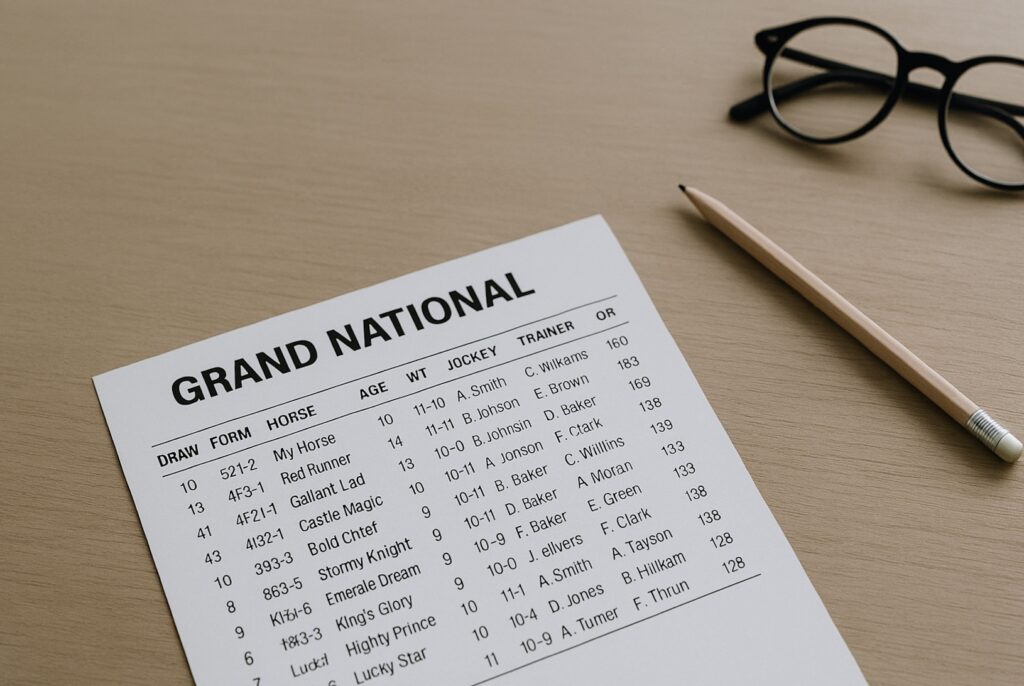
grand national cardsRace cards are essential for anyone following the Grand National. They provide key details about horse form, jockey statistics and track conditions, helping you make informed decisions during one of the most iconic events in horse racing. By learning how to interpret this information, you can better understand the runners and riders and enjoy a more strategic approach to the big day at Aintree.
The Grand National is a highlight of the racing calendar, attracting fans from across the world. A race card offers far more than a list of names. It presents a snapshot of the field, giving insights that can shape how you view the race. When combined with reliable updates such as boylesports results, a well-read card becomes a powerful tool to help you analyse the action and better understand potential outcomes.

How to interpret key information on race cards

At first glance, a race card can look complex. But once you break it down, every figure and symbol has meaning. A horse’s recent form is shown as a string of numbers and letters that represent finishing positions or special notes from previous races. Studying these allows you to gauge whether a horse is consistent, improving or out of form.

Jockey statistics are another critical factor. An experienced rider can have a significant influence on the race, using tactics and timing to get the best from their mount. Race cards list the jockey for each horse along with details of their recent record, giving you context for their potential impact.

Track conditions are equally important. Some horses relish softer going, while others perform better on good or firm ground. Cards often note the expected conditions for the day, helping you predict which horses might be suited to the surface.

Why the details matter

Race cards are full of subtle clues. One example is the weight each horse carries, a factor that becomes particularly important in the stamina-testing Grand National. A few extra pounds can make a difference over the famous 4 miles and 2½ furlongs.

The age and breeding of a horse can also help you assess its suitability. Younger horses may have speed and potential, while older ones bring experience and staying power. Similarly, understanding a trainer’s record at Aintree can be valuable, as some, like Gordon Elliott or Lucinda Russell, have a history of preparing horses specifically for the demands of this race.

Cross-referencing with BoyleSports results

Studying race cards in isolation is useful, but combining them with external data such as boylesports results can add another layer of insight. Reviewing past performances across different tracks and conditions helps highlight trends that might otherwise go unnoticed.

For example, a horse might show improved form when running on softer ground or over a certain distance, and those patterns are easier to identify when you cross-reference results. This method helps you build a clearer picture of each runner’s capabilities and limitations, making your analysis more informed.

For additional context, resources such as the British Horseracing Authority provide reliable information about rules, race entries and official statistics, which can support your understanding of the sport.

The value of a methodical approach

Using race cards effectively is about more than finding winners. It allows you to appreciate the finer details of the race and engage with the sport on a deeper level. By combining card analysis with reliable updates and historical results, you replace guesswork with informed assessment.

This approach will not guarantee success, but it ensures your decisions are grounded in fact, giving you a better sense of confidence when placing a bet or simply following the race. Over time, familiarity with race cards improves your understanding of racing strategy and makes the drama of the Grand National even more compelling.

Grand National Winners List

Below is a complete list of Grand National Winners by year and horse name only, starting from 1839 when Lottery was the winner all the way to the present day and recent Grand National 2026.

2026 – I Am Maximus
2025 – Nick Rockett
2024 – I Am Maximus
2023 – Corach Rambler
2022 – Noble Yeats
2021 – Minella Times
2020 – Abandoned – Covid-19
2019 – Tiger Roll
2018 – Tiger Roll
2017 – One For Arthur
2016 – Rule The World
2015 – Many Clouds
2014 – Pineau De Re
2013 – Auroras Encore
2012 – Neptune Collonges
2011 – Ballabriggs
2010 – Don’t Push It
2009 – Mon Mome
2008 – Comply Or Die
2007 – Silver Birch
2006 – Numbersixvalverde
2005 – Hedgehunter
2004 – Amberleigh House
2003 – Monty’s Pass
2002 – Bindaree
2001 – Red Marauder
2000 – Papillon
1999 – Bobbyjo
1998 – Earth Summit
1997 – Lord Gyllene
1996 – Rough Quest
1995 – Royal Athlete
1994 – Miinnehoma
1993 – VOID RACE
1992 – Party Politics
1991 – Seagram
1990 – Mr Frisk
1989 – Little Polveir
1988 – Rhyme ‘N’ Reason
1987 – Maori Venture
1986 – West Tip
1985 – Last Suspect
1984 – Hallo Dandy
1983 – Corbiere
1982 – Grittar
1981 – Aldaniti
1980 – Ben Nevis
1979 – Rubstic
1978 – Lucius
1977 – Red Rum
1976 – Rag Trade
1975 – L’Escargot
1974 – Red Rum
1973 – Red Rum
1972 – Well To Do
1971 – Specify
1970 – Gay Trip
1969 – Highland Wedding
1968 – Red Alligator
1967 – Foinavon
1966 – Anglo
1965 – Jay Trump
1964 – Team Spirit
1963 – Ayala
1962 – Kilmore
1961 – Nicolaus Silver
1960 – Merryman II
1959 – Oxo
1958 – Mr What
1957 – Sundew
1956 – E.S.B.
1955 – Quare Times
1954 – Royal Tan
1953 – Early Mist
1952 – Teal
1951 – Nickel Coin
1950 – Freebooter
1949 – Russian Hero
1948 – Sheila’s Cottage
1947 – Caughoo
1946 – Lovely Cottage
1941/45 – No Race
1940 – Bogskar
1939 – Workman
1938 – Battleship
1937 – Royal Mail
1936 – Reynoldstown
1935 – Reynoldstown
1934 – Golden Miller
1933 – Kellsboro’ Jack
1932 – Forbra
1931 – Grakle
1930 – Shaun Goilin
1929 – Gregalach
1928 – Tipperary Tim
1927 – Sprig
1926 – Jack Horner
1925 – Double Chance
1924 – Master Robert
1923 – Sergeant Murphy
1922 – Music Hall
1921 – Shaun Spadah
1920 – Troytown
1919 – Poethlyn
1916-1918 – No Race At Aintree
1915 – Ally Sloper
1914 – Sunloch
1913 – Covertcoat
1912 – Jerry M
1911 – Glenside
1910 – Jenkinstown
1909 – Lutteur III
1908 – Rubio
1907 – Eremon
1906 – Ascetic’s Silver
1905 – Kirkland
1904 – Moifaa
1903 – Drumcree
1902 – Shannon Lass
1901 – Grudon
1900 – Ambush II
1899 – Manifesto
1898 – Drogheda
1897 – Manifesto
1896 – The Soarer
1895 – Wild Man
1894 – Why Not
1893 – Cloister Bill
1892 – Father O’Flynn
1891 – Come Away
1890 – Ilex
1889 – Frigate
1888 – Playfair
1887 – Gamecock
1886 – Old Joe
1885 – Roquefort
1884 – Voluptuary
1883 – Zoedone
1882 – Seaman
1881 – Woodbrook
1880 – Empress
1879 – The Liberator
1878 – Shifnal
1877 – Austerlitz
1876 – Regal
1875 – Pathfinder
1874 – Reugny
1873 – Disturbance
1872 – Casse Tete
1871 – The Lamb
1870 – The Colonel
1869 – The Colonel
1868 – The Lamb
1867 – Cortolvin
1866 – Salamander
1865 – Alcibiade
1864 – Emblematic
1863 – Emblem
1862 – The Huntsman
1861 – Jealousy
1860 – Anatis
1859 – Half Caste
1858 – Little Charley
1857 – Emigrant
1856 – Freetrader
1855 – Wanderer
1854 – Bourton
1853 – Peter Simple
1852 – Miss Mowbray
1851 – Abd-EI-Kader
1850 – Abd-El-Kader
1849 – Peter Simple
1848 – Chandler
1847 – Matthew
1846 – Pioneer
1845 – Cure-All
1844 – Discount
1843 – Vanguard
1842 – Gay Lad
1841 – Charity
1840 – Jerry
1839 – Lottery

7 Cheltenham Gold Cup Winners Who Ran In The Aintree Grand National

The pinnacle of racing at the Cheltenham Festival saw a fascinating renewal of the Gold Cup. Inothewayurthinkin, trained by Gavin Cromwell, ridden by Mark Walsh, and owned by the richest man from Limerick, J.P. McManus, proved a worthy winner. The seven-year-old gelding left Galopin Des Champs in his wake, returning at odds of 15/2. The Willie Mullins-trained horse and hope for three consecutive wins was dismissed.

The exciting victory proved the intentions of J.P. McManus, a billionaire businessman, professional gambler, and softly spoken Irishman.

McManus spends his money well.

But what added to this brilliant success was the intention and plan for Inothewayurthinkin to win the Aintree Grand National. However, those hopes were dashed with the news that he will head to Punchestown for the Ladbrokes-sponsored Gold Cup.

Considering McManus won the 2024 Grand National with I Am Maximus, trained by Willie Mullins and given a fine ride by Paul Townend, there is little doubt he has his eye on second helpings. If you take a look at the betting, you will find that J.P. has three horses high in the market, and it would take a brave bookmaker to consider he won’t take the spoils.

Go back in time and ask bookmaker Fearless Freddie Williams, who lost over a million on one thankless day at Cheltenham.

To McManus, it was little more than playing with Monopoly money.

The Aintree Grand National isn’t far away, and there is a real buzz about the most famous steeplechase in the world.

But here’s a question: How many Gold Cup winners have taken their chance in the Aintree Grand National?

Let’s take a look at seven horses that did just that.

It is worth noting that the Cheltenham Gold Cup was inaugurated in 1924.

In chronological order:

1934: Golden Miller

A true horse racing icon. Owned by Dorothy Paget, not only did Golden Miller win the Gold Cup five times in succession, but he is the only horse to achieve the Gold Cup/Grand National double in the same year (1934). Considering Golden Miller hated Aintree, it showed his class.

1975: L’Escargot

A two-time winner of the Gold Cup (1970, 1971). An exceptional horse trained by Dan Moore and owned by Raymond G. Guest. At the age of 12, he won the 1975 Grand National, beating Red Rum, who was attempting his third consecutive win. It was an imperious victory.

1991: Garrison Savannah

Jenny Pitman’s charge won the Cheltenham Gold Cup in 1991, beating The Fellow by a short head. Mark Pitman took the ride on the 7/1 shot and finished a gallant second behind Seagram, who ran out an eight-length winner.

1994: The Fellow

A very determined horse who was beaten on two occasions in the Gold Cup by a short head (1991, 1992) before tasting victory in 1994 for François Doumen. However, heading to the Grand National that same year didn’t reap rewards, as the 9/1 shot fell at Canal Turn (24th fence).

1995: Master Oats

Kim Bailey’s nine-year-old gelding ran out an easy 15-length winner at 100/30, ridden by Norman Williamson. Master Oats headed to the Grand National in the same year and was fancied to go well as the 5/1 favourite. However, a hefty weight of 11-10 saw him tire in the closing stages to finish seventh, beaten 15 ¾ lengths. Master Oats made another attempt to win the National in 1997, finishing fifth. He enjoyed an honourable retirement.

This son of Oats out of Miss Poker Face was a true star, winning 10 of his 21 starts. When you consider his first attempt at the Grand National (1994) saw him fall at the 13th fence when carrying only 10-0, you have to think it was a missed opportunity. A very talented horse.

2012: Synchronised

A very popular horse. He won the 2012 Cheltenham Gold Cup, ridden by Tony McCoy for trainer Jonjo O’Neill in the ownership of J.P. McManus. The nine-year-old beat The Giant Bolster by two and a quarter lengths (50/1), with Long Run in third. Synchronised was priced at 8/1.

He headed to the Aintree Grand National (2012) with top weight (11-10). Priced at 10/1, he was a major hope for Tony McCoy to gain his first National win. Sadly, Synchronised fell at Becher’s Brook (6th fence) and continued riderless. He fell again at the 11th fence and fractured his right hind tibia and fibula. Tragically, Synchronised lost his life.

2014: Long Run

The 2011 Gold Cup winner triumphed at odds of 7/2f, beating the mighty Denman by seven lengths, with Kauto Star in third. Ridden by Sam Waley-Cohen and owned by his father Robert.

Interestingly, Long Run made only one attempt at the Grand National in 2014. The nine-year-old carried 11-9 and was priced at 12/1. He fell at Valentine’s (9th fence).

Many horses have competed in both the Gold Cup and the Aintree Grand National. In fact, more horses have taken their chance than I would have imagined. However, the records show that winning both is a rare achievement.

Golden Miller and L’Escargot both accomplished this feat, but the former is the only horse to do the double in the same year. Clearly, all Gold Cup winners have proven class, but this means they have to shoulder extreme weight when tackling the longer distance and gruelling course of Aintree.

It is no easy task.